
Author: Ingrid Ravasi

For decades, environmental education has faced a fundamental challenge: how do we connect people to an underwater world that is as vast as it is inaccessible? Not everyone lives near the coast, and not everyone can access diving experiences, travel opportunities, museums, or fieldwork.
In museums and other cultural institutions, this challenge was long linked to an “exhibit-centric” educational model, focused on the static display of objects. Today, however, a paradigm shift is underway. Increasingly, institutions are embracing a “visitor-centric” approach, where the focus is on experience, emotion, and interaction.
This is where augmented reality comes into play, enabling the creation of immersive, memorable experiences that place visitors at the center of the story.
Augmented reality is a technology that overlays digital content, such as 3D models, animations, and videos, onto the real world, as viewed through the camera of a mobile device. Within the framework of Ocean Literacy, its potential is especially powerful: AR fosters interaction, transforming the viewer from a passive observer into an active explorer. Thanks to this technology, you don’t just read information, you discover and experience it firsthand.
Photo via Canva
Traditional exhibitions often place a physical barrier between the visitor and the exhibit: you can look, but you cannot interact. AR breaks down this barrier, making the experience engaging and interactive.
A striking example is the Bone Hall at the Smithsonian National Museum of Natural History. Once a silent gallery of skeletons, it was transformed by the Skin & Bones app. By pointing a smartphone at a specimen, visitors can see muscles, skin, and movement digitally reconstructed. Suddenly, skeletons are no longer frozen in time: they walk, swim, and hunt.
Data collected revealed a significant increase in visitor engagement, with people spending more time at the exhibits. Even more remarkable was the social impact: rather than isolating visitors, AR sparked unexpected interactions with children and adults spontaneously gathering around those using the app, turning an individual experience into a shared moment of discovery.
The educational potential of AR extends far beyond museum walls, with the strategic goal of democratizing access to ocean knowledge, making it a tool for social inclusion as well as education. Bringing these immersive experiences directly into classrooms and homes means reaching people who live far from the coast, turning a screen into a portal to the underwater world.
The Kelp Forest Foundation project in Namibia perfectly embodies this vision. Despite having over 1,500 km of coastline, 91% of the population lives inland, and many people have never seen the Ocean. For them, the sea often remains an abstract idea. Through AR apps and headsets, children can “dive” into local kelp forest ecosystems, developing a deeper emotional connection with the marine environment.
Because to protect something, you must first love it. And to love it, you need to feel close to it.
Every time we physically enter the sea, even with the best intentions, we can leave a trace: we may disturb animals, stir up sediment, accidentally touch fragile organisms, or stress sensitive habitats.
Augmented Reality enables us to learn through exploration without impact. We can virtually swim alongside a dolphin, explore a coral reef, or visit an underwater archaeological site, all while preserving their integrity.
One example is the i-Mare Culture project, which uses interactive technologies and AR to make the submerged archaeological heritage of the Mediterranean accessible to all. Sites that would otherwise require technical diving become explorable by anyone, delivering a dual benefit: accessibility and protection.
Within the Capo Milazzo Marine Protected Area (MPA), which hosts one of Worldrise’s SEATYs, there is also an immersive virtual and augmented reality experience inside the “Stanza del Mare” (Sea Room). This technology allows visitors to explore the seabed and local marine life without the need for physical diving, offering a virtual excursion to discover the wonders of the MPA.
Large-scale and complex phenomena such as marine pollution or ocean acidification are often perceived as distant and abstract problems. This sense of disconnection makes it difficult to inspire collective action, as people struggle to see these issues as personally relevant.
AR has the power to close this gap by bringing these processes into your everyday surroundings. The Eco Animals app does exactly this. By overlaying 3D models onto the real environment, it shows us the devastating effects of pollution on marine life, prompting us to reflect on our own consumption habits.
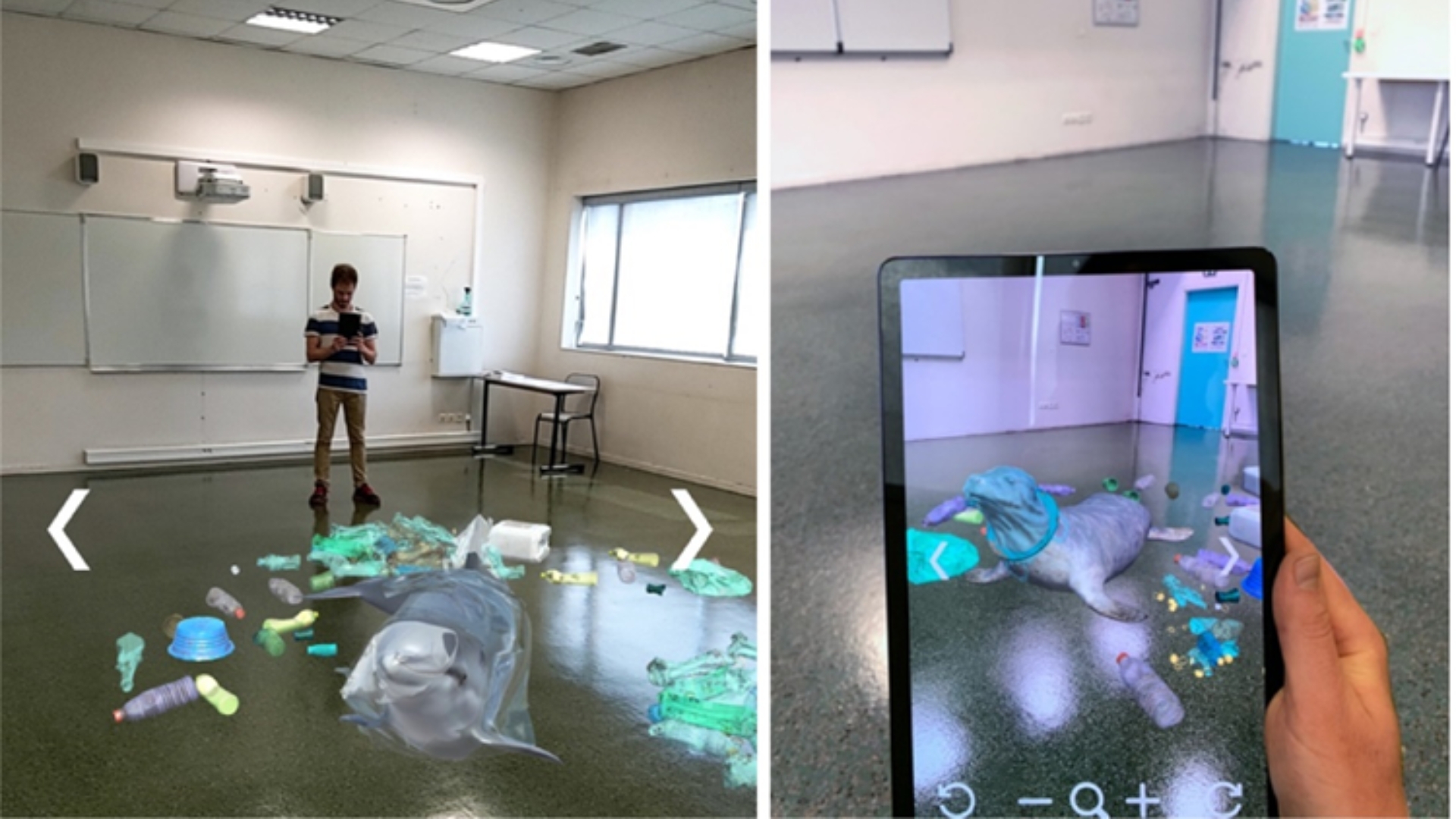
Detail from the study “Raising environmental awareness with augmented reality” by G. Attanasi, B. Buljat Raymond, A. Festré, and A. Guido
What makes AR such a powerful tool for building emotional connection and inspiring action? Three key mechanisms stand out:
• Active Exploration: You don’t just receive a lesson; you experience it. Interaction reignites curiosity and turns learning into active exploration.
• Seeing the Invisible: Observing the real-time effects of complex phenomena, such as climate change or plastic pollution, layered onto your own environment makes threats tangible and urgent.
• Emotional Connection: Immersiveness bridges knowledge and emotion, fostering wonder, closeness, and responsibility, the foundations of empathy and action.
This emotional bond creates a direct link between technological experience and global conservation goals, contributing to the advancement of UN Sustainable Development Goal 14: Life Below Water.
Augmented Reality breaks down long-standing barriers, making marine exploration more inclusive and laying the emotional foundations for a new Blue Generation: informed, aware, and ready to act.
It is no longer just about reading about ocean challenges, but about experiencing them firsthand to help solve them. No longer about imagining the beauty of the sea, but about exploring it. From this immersive experience, love and responsibility emerge: the true drivers of change.
When used thoughtfully, with care and in a sustainable way, technology can become a powerful ally in raising awareness of the value of our oceans.
Photo via Canva
• Attanasi, G., Buljat Raymond, B., Festré, A., & Guido, A. (2025). Raising environmental awareness with augmented reality. Ecological Economics, 233(108563).
• Hagen, O., Aly, A., Jones, R., Varga, M., & Bazazian, D. (2024). Beyond the surface: a scoping review of vision-based underwater experience technologies and user studies. Intelligent Marine Technology and Systems, 2(19)
• Kelp Forest Foundation. (2022). Bringing kelp forests into the classroom through AR/VR app. MIT Solve. https://solve.mit.edu/solutions/61869
• Sun, X., Lee, K. E., & Lim, C. K. (2025). The integration of sustainable development elements into interaction design for ocean conservation education in natural history museum: A review. Sustainable Futures, 10(101260).
• Marques, D. C. V. (2017). The Visitor Experience Using Augmented Reality on Mobile Devices in Museum Exhibitions. [Tesi di dottorato, Faculdade de Letras da Universidade do Porto].
• 3D Research Srl. (n.d.). iMARE CULTURE. https://www.3dresearch.it/it/underwater-it/progetti/imareculture-it/

Ocean Facts
Author: Ingrid Ravasi


Ocean Facts
Author: Sara Allahverdiyeva


Ocean Facts
Author: Sara Allahverdiyeva


