
The Glaucus atlanticus Forster 1777 is a marvelous mollusk belonging to the Gasteropoda class. It is a close sibling of the terrestrial snails, differing from them due to its lack of a protective external shell (Nudibranchia order).
This intriguing marine organism is better known by its nickname, the Blue Dragon, because of the morphology of its lateral appendages, which resemble a dragonʼs wingspan, despite it being no longer than 6cm. This tiny mollusk displays vivid coloration, ranging from brilliant cobalt blue to silvery white on the ventral side, while the dorsal side is silvery gray.
The Blue Dragon is widely distributed, and found in all oceans across the tropical and subtropical zones, extending as far as Madagascar and South Africa. Recently, it has been found in the Mediterranean Sea. It’s adaptable and easily adjustable to various environmental conditions.
It leads a pelagic lifestyle either drifting with the currents or swimming lazily. It doesn’t live in deep water; instead, it floats on the water’s surface due to an air bubble in its stomach. Thanks to this mechanism, it falls under the category of neuston, which refers to organisms that live in close contact with the water’s surface.


Photo via Canva
One of the most curious features of G. atlanticus is its habit of living on its stomach. Floating on the water’s surface, the Blue Dragon shows its silvery underside to the sky and its blue upper side to the ocean. This is not a casual behavior: the back blue coloring makes it less visible to predators looking from below, while the silvery venter camouflages with the shining sky to protect from predators above. This camouflage strategy, called counterillumnation, is one of the several marvels of evolution.
Thanks to the surface tension of water, the Glaucus atlanticus can keep itself afloat. it maintains a horizontal position thanks to a small air sac in its body. This floating method allows it to easily drift on the water’s surface, following the ocean currents. In addition, this constant movement permits it to explore new areas in search of food while avoiding exposing itself to natural enemies.
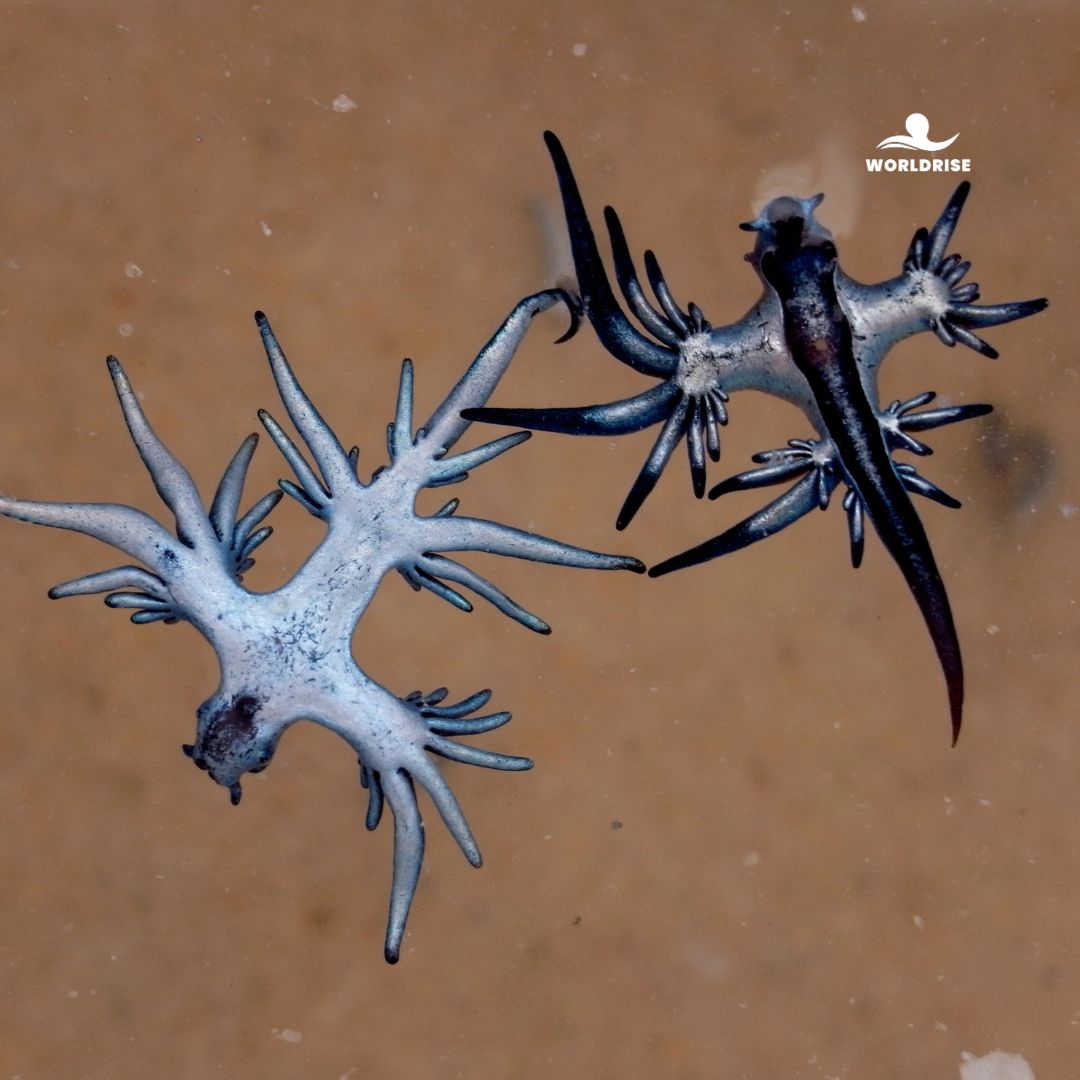

Photo via Canva
Despite their harmless and docile appearance, they are voracious predators that feed mainly on floating Hydrozoa, particularly colonial species such as Portuguese Caravels (Physalia physalis Linnaeus, 1758) or St. Peter’s boats (Velella velella Linnaeus 1758).
This animal has developed a particular technique to exploit the venomous tentacles of these siphonophores: it stores their toxins inside of its lateral appendages, called cerata. Storing urticating nematocysts acts as a powerful deterrent for predators. This means that even if a predator manages to spot it despite its excellent camouflage, it will face a dangerous and potentially lethal meal.
Therefore, if you ever encounter one, remember not to touch it!


Photo via Canva
Another interesting aspect of G. atlanticus’ life is its social behavior. Although these nudibranchs are rather solitary, they can sometimes be found in groups, floating together on the water’s surface. This behavior may be related to either their sexual reproduction or simply the influence of marine currents pushing them in the same direction.
The reproduction of the Blue Dragon is equally fascinating. Indeed, these nudibranchs are hermaphrodites, which means they possess both male and female reproductive organs. When two G. atlanaticus encounter each other, they exchange sperm and fertilize each other’s eggs. The eggs are then released en masse into the water, where they develop into larvae and eventually transform into small blue dragons.

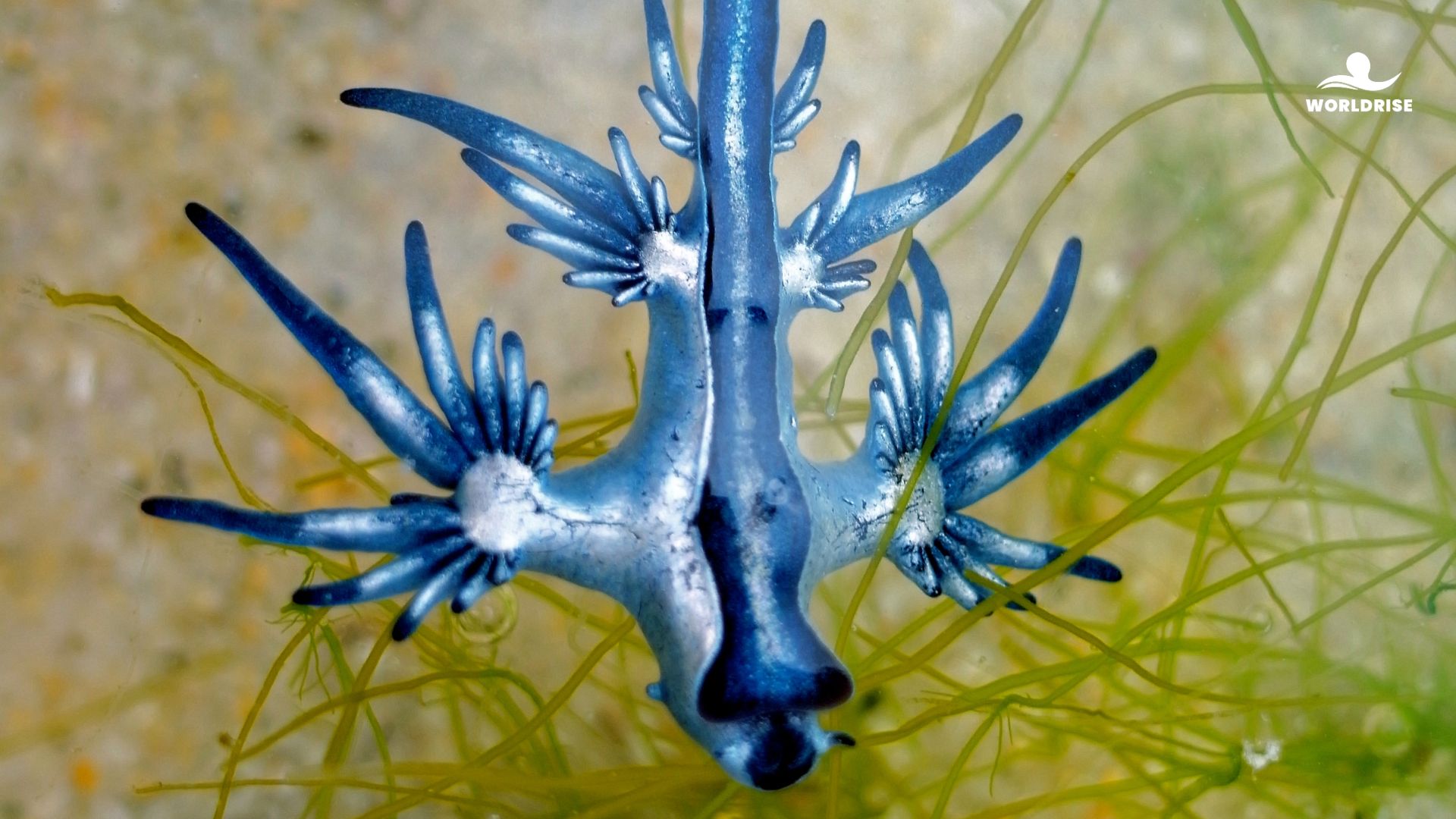
Photo via Canva
Glaucus atlanticus, or Blue Dragon, is a majestic example of evolutionary adaptation and marine beauty. It demonstrates how even one of the smallest creatures can significantly impact the ecosystem, with its outstanding camouflage and defensive skills. Its presence around the seas worldwide reminds us of the importance of protecting and respecting marine biodiversity. Meeting this mollusk would be a unique experience; however, always remember to observe and not touch it to avoid its harmful toxins.
• https://www.marinespecies.org/aphia.php?p=taxdetails&id=140022&images
• http://www.seaslugforum.net/find/glauatla
• https://ejournals.epublishing.ekt.gr/index.php/hcmr-med-mar-sc/article/view/32369
• https://www.mare2000.it/Invertebrati/glaucus.htm
• https://doi.org/10.1007/s41208-024-00706-1
• https://thecoastnews.com/blue-beach-blobs-cause-headaches-for-local-dog-owners/
• https://thecoastnews.com/blue-beach-blobs-cause-headaches-for-local-dog-owners/

Ocean Facts
Author: Ingrid Ravasi

Blue Growth
Author: Ingrid Ravasi


Ocean Facts
Author: Sara Allahverdiyeva


Ocean Facts
Author: Sara Allahverdiyeva


