
Author: Sara Allahverdiyeva

The duration of fishing gear refers to the active period of time during which a ghost net continues to trap and kill marine life. Studies estimate that the catch duration can vary from 30 to 568 days, but the range depends on gear type, environmental conditions, and material durability. Let’s examine each factor:
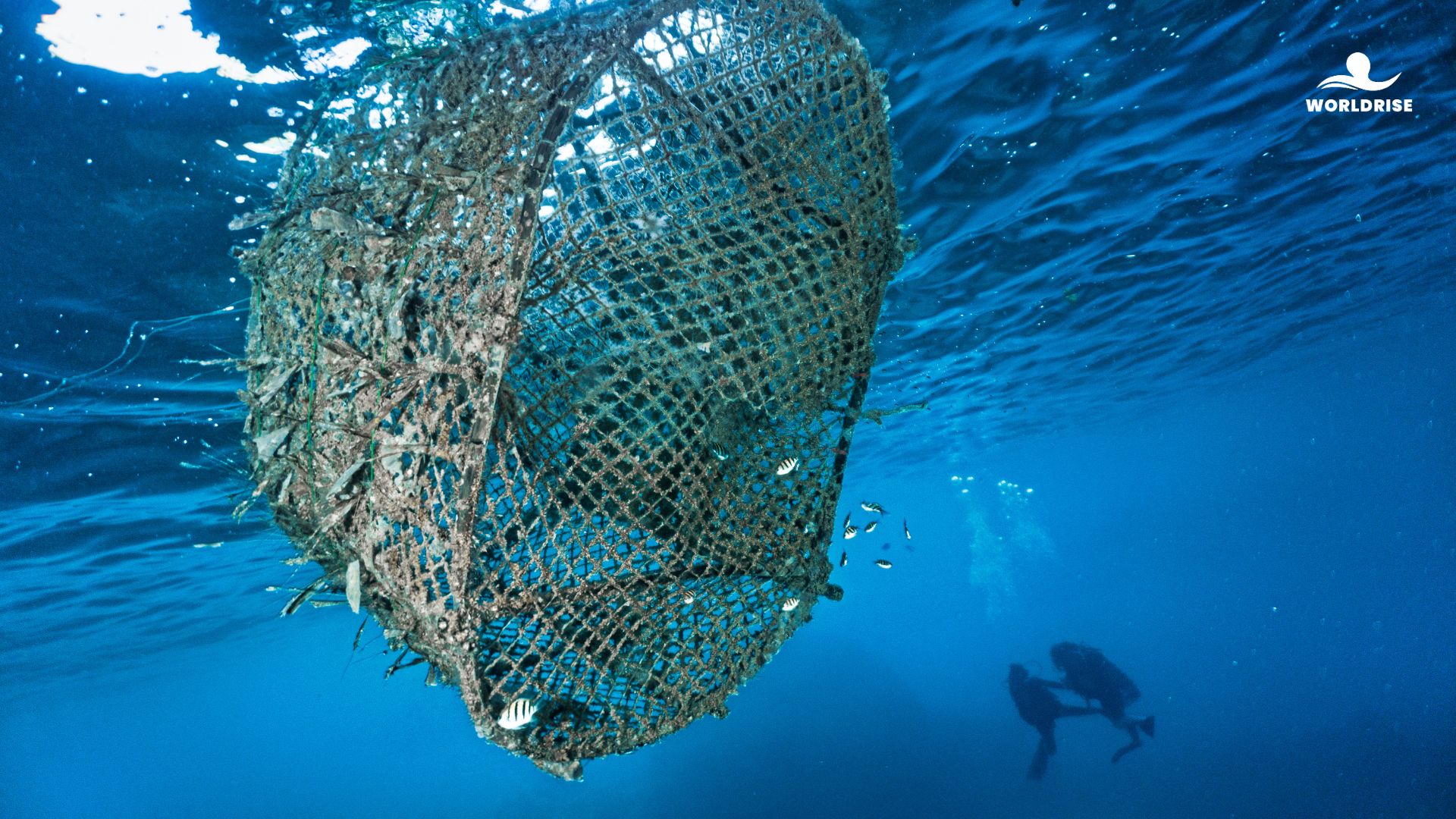
Photo by Canva
1. Marine organisms’ mortality
Gillnets, nets, traps, longlines, trawls, and dredges, remaining operational after being discharged, trap marine organisms such as fish, mammals, turtles, and crustaceans, ultimately leading them to death. Although there is a chance of survival for trapped species, it is significantly reduced due to the stress and starvation experienced by marine organisms during attempts to escape. Research shows that the fish survival rate was only 1–2%, while no more than 50% of the crustaceans survived. Shelled molluscs are less vulnerable to fishing gear, with significantly higher survival rates. A study conducted in Puget Sound in 2022 showed that one lost net can kill approximately 5 marine mammals, 556 invertebrates, 178 fish, and 4 seabirds over a period of 50 years.
2. Habitat destruction
ALDFG can cause significant damage to sensitive marine habitats such as coral reefs, seagrass meadows, and soft-bottom environments. Drifting fishing gear can destroy corals and disrupt the structure of the seabed, destroying the functionality of ecosystems. In some cases, ALDFG can function as artificial reefs, presenting conditions for colonization by marine organisms such as barnacles, sponges, and seaweeds. However, ghost nets do not provide the ecological benefits of a natural surface because, over time, as ALDFG degrades, microplastics and harmful chemicals enter the water and consequently the food chain. Furthermore, ALDFG can even block sunlight penetration in the water and disrupt oxygen flow, especially in shallow coastal areas, impacting photosynthetic organisms and leading to habitat degradation.
3. Pollution
Fishing gear makes up approximately 10–20% of all litter in the ocean and up to 70% of large floating plastics in some regions, since ALDFG commonly consists of nylon, polyethylene, and polypropylene, which persist in the ocean for decades or centuries and become part of marine debris. ALDFG is one of the most dangerous forms of debris because of its material durability, wide distribution, microplastic accumulation, and the threat it poses to marine life.
ALDFG, in fact, over time breaks down into smaller pieces, releasing microplastics into the marine environment. Microplastics are ingested by marine species and enter the food chain, leading to reproductive diseases, developmental disorders, immune toxicity, and genetic damage among marine organisms. In addition to microplastics, parts of the ALDFG can be swallowed by marine species, causing suffocation and immediate death.
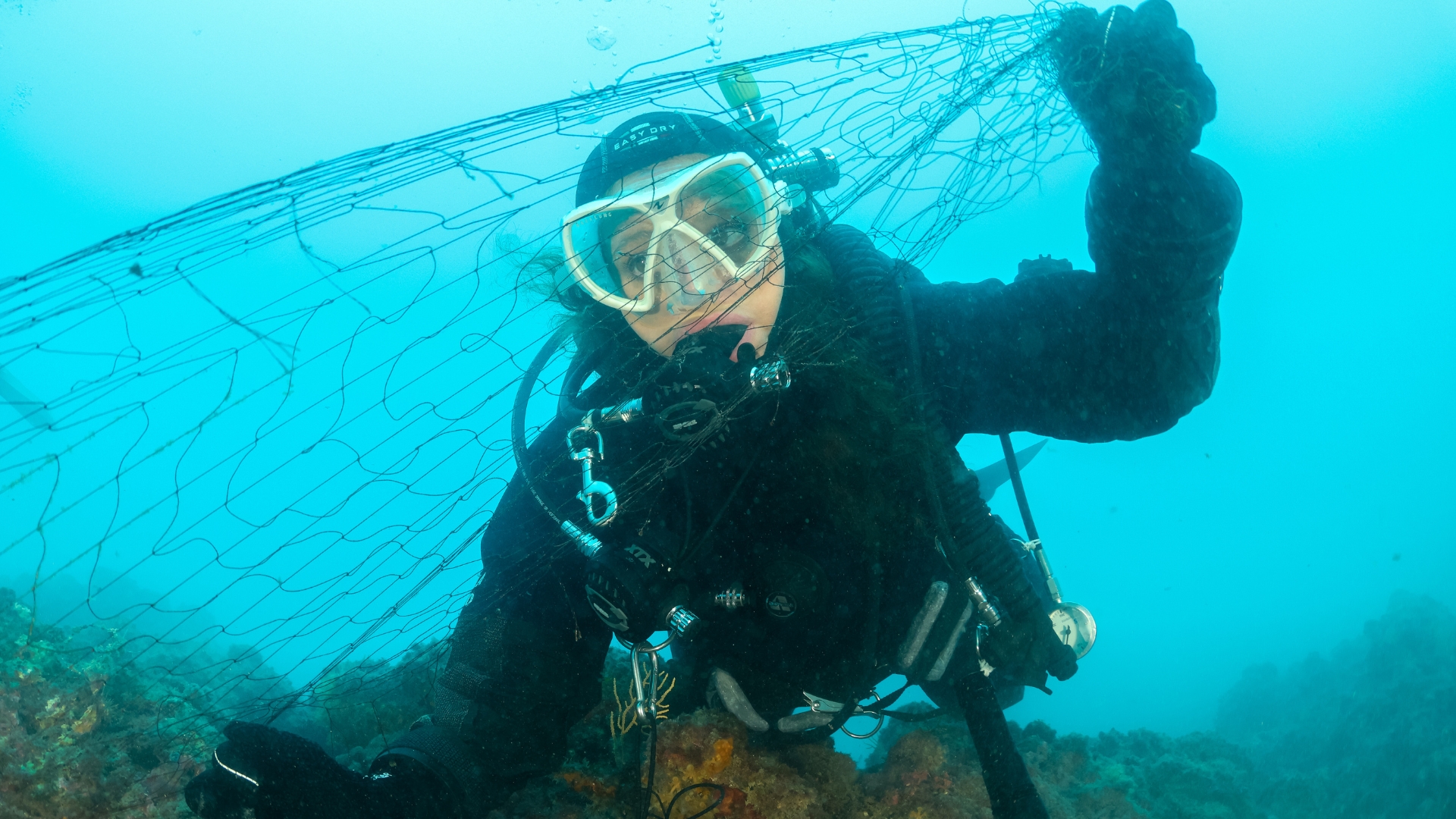
Photo by Worldrise
To solve the various problems associated with ALDFG, several strategies can be implemented:
• Prevention actions: Implementing more durable designs for fishing gear can reduce accidental loss during fishing activities. Integrating GPS or RFID tracking technologies would enable fishers to monitor and retrieve their gear in case of drifting. Besides, providing educational training and awareness-building moments for fishermen is essential, ensuring that they follow best practices to handle their gear correctly in the event of sinking. Another important measure is the marking of fishing gear with identifiers, making it possible to trace gear back to its owner and discourage irresponsible disposal.
• Mitigation actions: The use of biodegradable materials, such as hemp, cotton, or plant-based elements in fishing gear, could significantly reduce marine organism mortality and harmful effects, preventing pollution. Another effective approach is to implement gear recovery programs that encourage fishers and divers to report ALDFG when found.
• Remediation: Organizing ghost net recovery activities with divers and fishermen, and involving them in ecosystem restoration where habitats have already been impacted by ALDFG, can be a way to become part of the solution.
• K. Richardson, C. Wilcox, J. Vince, and B. D. Hardesty, “Challenges and misperceptions around global fishing gear loss estimates,” Marine Policy, vol. 129, p. 104522, Jul. 2021, doi: https://doi.org/10.1016/j.marpol.2021.104522.
• J. A. Lively and T. P. Good, “Ghost Fishing,” World Seas: An Environmental Evaluation, vol. 3, pp. 183–196, 2019, doi: https://doi.org/10.1016/b978-0-12-805052-1.00010-3.
• M. Angiolillo, “Debris in Deep Water,” World Seas: An Environmental Evaluation, pp. 251–268, 2019, doi: https://doi.org/10.1016/b978-0-12-805052-1.00015-2.
• X. I. Loizidou, D. L. Orthodoxou, and R. Godet, “Bioplastic fishing nets as a sustainable alternative against ghost fishing: Results from the year-long testing among artisanal fishermen for operational effectiveness and social acceptance,” Marine Pollution Bulletin, vol. 209, p. 117300, Nov. 2024, doi: https://doi.org/10.1016/j.marpolbul.2024.117300.
• S. H. Thorbjørnsen, A.-E. W. Synnes, I. D. Løset, and A. R. Kleiven, “Hazard and catch composition of ghost fishing gear revealed by a citizen science clean-up initiative,” Marine Policy, vol. 148, p. 105431, Feb. 2023, doi: https://doi.org/10.1016/j.marpol.2022.105431.
• R. Cook, “THE MAGNITUDE AND IMPACT OF BY-CATCH MORTALITY BY FISHING GEAR.” Reykjavik, Iceland, 1-4 October 2001,https://www.fao.org/fishery/docs/DOCUMENT/reykjavik/pdf/13Cook.pdf
• “Mortality of fish escaping trawl gears,” Fao.org, 2025. https://www.fao.org/4/y6981e/y6981e06.htm
• “THE IMPACT OF FISHING GEAR AS A SOURCE OF MARINE PLASTIC POLLUTION.” Available: https://oceanconservancy.org/wp-content/uploads/2022/06/UNEA5.2_GGGI.pdf
• B. D. Hardesty, T. P. Good, and C. Wilcox, “Novel methods, new results and science-based solutions to tackle marine debris impacts on wildlife,” Ocean & Coastal Management, vol. 115, pp. 4–9, Oct. 2015, doi: https://doi.org/10.1016/j.ocecoaman.2015.04.004.
• Y. Li, Y. Sun, J. Li, R. Tang, Y. Miu, and X. Ma, “Research on the Influence of Microplastics on Marine Life,” IOP Conference Series: Earth and Environmental Science, vol. 631, no. 1, p. 012006, Jan. 2021, doi: https://doi.org/10.1088/1755-1315/631/1/012006.

Ocean Facts
Author: Ingrid Ravasi

Blue Growth
Author: Ingrid Ravasi


Ocean Facts
Author: Sara Allahverdiyeva

Lifestyle
Author: Sara Allahverdiyeva

Events
Authors: Marta Curri, Claudia Pintore and Andrea Carlini
